Taproot Addresses 101
If you've used Bitcoin for more than a year, you've seen addresses that start with 1, 3, bc1q, and bc1p. They're all valid Bitcoin addresses. They all hold real BTC. But they're not the same thing, and the difference between them matters for your fees, your privacy, and (occasionally) which wallets can send to you.
This guide gives you a five-minute mental model: how to read a Bitcoin address at a glance, what each format actually does on-chain, and which one your KeepKey Desktop should be using by default.
The five address formats, in one table
| Prefix | Name | Example | Introduced | Why use it |
|---|
1... | Legacy (P2PKH) | 1A1zP1eP5QGefi2DMPTfTL5SLmv7DivfNa | 2009 | Universal compatibility |
3... | P2SH-wrapped SegWit | 3J98t1WpEZ73CNmQviecrnyiWrnqRhWNLy | 2017 | Lower fees, broad wallet support |
bc1q... | Native SegWit (Bech32) | bc1qw508d6qejxtdg4y5r3zarvaryv9n3jc6 | 2017 | Lowest fees among "old" formats |
bc1p... | Taproot (Bech32m) | bc1p5cyxnuxmeuwuvkwfem96l9szl4c5zcqljas6jap | 2021 | Best privacy + smart-contract flexibility |
bc1pp/
bc1pq... | Inscriptions/Ordinals | varies | 2023+ | Same Taproot prefix, different content |
The first character (and prefix in bc1... addresses) tells you immediately what kind of script the address commits to.
Reading the prefix at a glance
- Starts with
1 → Legacy. Oldest format. Highest on-chain footprint per transaction (and so highest fees). Some very old hardware wallets still default to this. There is no real reason to use it for new addresses today.
- Starts with
3 → P2SH. Could be SegWit-wrapped, but not necessarily — it could also be a multi-sig or any other P2SH script. From the receiving side you can't tell which without looking at the script. As a default for SegWit it's about 25% smaller than Legacy.
- Starts with
bc1q → Native SegWit (a.k.a. Bech32). Smaller still. The format Bitcoin Core has recommended since 2017. Detects typos better than Base58 thanks to its checksum.
- Starts with
bc1p → Taproot (Bech32m). The 2021 upgrade. Improved privacy: a single Taproot output is indistinguishable from a single-sig output, a multi-sig output, or a complex smart contract — observers can't tell. Cheaper for complex spends.
If your address starts with anything else, you're looking at testnet (m, 2, tb1q, tb1p), an old Litecoin-style address that was sent to a Bitcoin wallet by mistake, or a typo.
What changes on-chain — the practical differences
Fees
The fee you pay depends on how many bytes your transaction takes. Each address format has a different on-chain footprint per signature.
Roughly (single-input, single-output spend):
| Format | Approx. tx size | Fee at 30 sat/vB |
|---|
Legacy (1...) | ~226 bytes | 6,780 sat |
P2SH-SegWit (3...) | ~166 bytes | 4,980 sat |
Native SegWit (bc1q...) | ~141 bytes | 4,230 sat |
Taproot (bc1p...) | ~111 bytes | 3,330 sat |
Over a year of activity, the fee difference between Legacy and Taproot is real money, especially during high-fee periods.
Privacy
This is the under-discussed Taproot win. Pre-Taproot, the script type of an output is visible to anyone watching the chain. A 3... address with a 2-of-3 multi-sig spend pattern is identifiable as such. A native SegWit single-sig is identifiable as a single-sig.
Taproot collapses this. A Taproot output spent via the "key path" (the cooperative case) looks identical to any other Taproot single-sig output — even if the output was secured by a complex script with multiple co-signers and time-locks underneath. From the chain's perspective, all happy-path Taproot spends are indistinguishable.
For a hardware-wallet user holding cold storage, that means the size of your wallet, the kind of script you're using, and the existence of multi-sig setups become significantly harder to fingerprint from on-chain analysis.
Smart-contract flexibility
Taproot also adds MAST (Merkleized Alternative Script Trees), which let scripts have multiple unlock conditions where only the one actually used gets revealed on-chain. Combined with Schnorr signatures (also part of the Taproot upgrade), this enables more compact and more private multi-sig and other contract patterns. For most users, this is invisible — but it's the foundation modern Bitcoin tooling builds on.
Which one does my KeepKey use?
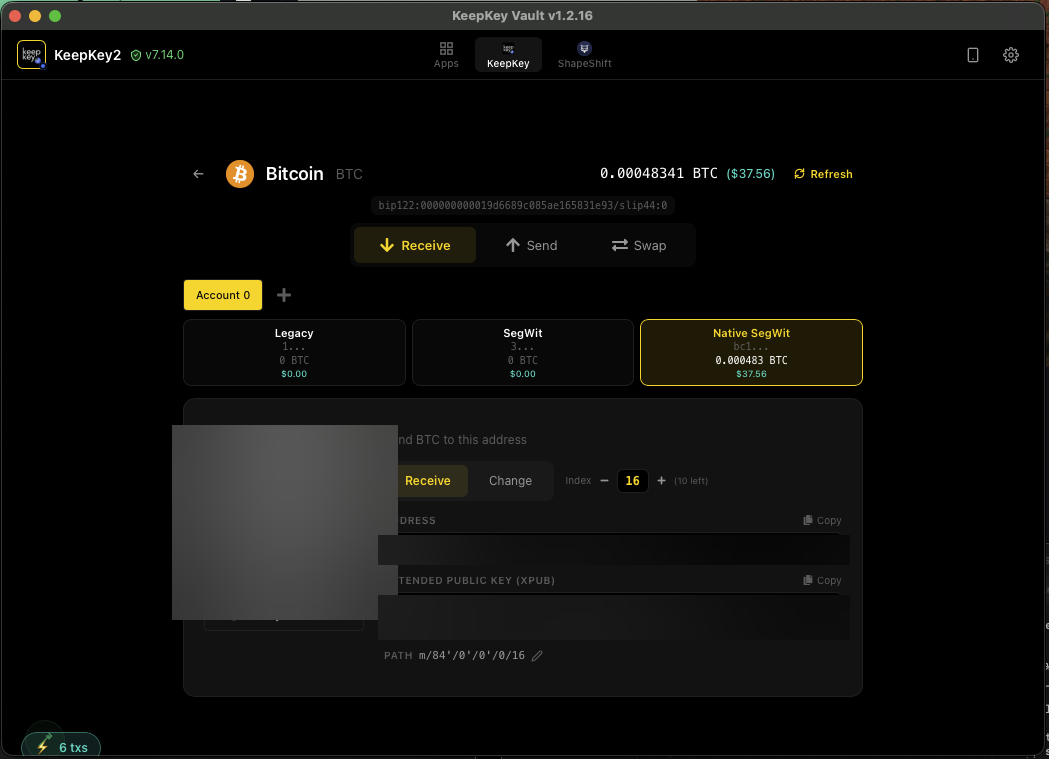
A KeepKey running current firmware in KeepKey Desktop generates Native SegWit (bc1q...) addresses by default and also supports Taproot (bc1p...). You can switch between formats per-address-type when generating receive addresses.
To see and copy a receive address:
- Open KeepKey Desktop and unlock the device
- Go to your Bitcoin account
- Click Receive
- The receive address is shown along with a QR code; the format depends on the address type configured for the account
Always verify the address on the device's screen before copying it to use. The desktop app could be compromised; the device cannot.
Sending to / receiving from different formats
- Anyone can send to anyone. Format compatibility is the sender's wallet's job. A modern wallet sends to all formats with no special handling.
- Receiving works the same. Your KeepKey can receive at a
1..., 3..., bc1q..., or bc1p... address — pick the type when you generate the receive address.
- You don't have to consolidate. It's fine to have a mix of formats in a wallet. KeepKey Desktop tracks them all together.
The only caveat: very old wallets (pre-2017, or some custodial services that haven't updated) may not support sending to Bech32 or Bech32m. If a sender tells you "your address looks weird," give them a 3... (P2SH-SegWit) address as a fallback. Modern wallets have no such issue.
Quick reference card
1... → Legacy. Avoid for new addresses.3... → P2SH (often SegWit-wrapped). Still widely supported; use as fallback for old senders.bc1q... → Native SegWit. Default for most wallets in 2026. Lower fees.bc1p... → Taproot. Best privacy + lowest fees. Use this if every counterparty supports it.
By recognizing these differences, you can choose the format that best fits your priorities — compatibility, efficiency, or privacy — and you can sanity-check that the address someone gave you is the kind of address you're expecting before you hit send.
Related